The forehand loop is the first real attacking weapon most players add once the basics feel comfortable. It sits a level above the four foundation shots: the forehand drive, backhand drive, forehand push and backhand push.
If those four still feel shaky, spend more time there first. The loop borrows heavily from the drive’s mechanics.
This guide covers the forehand loop only. The backhand loop is a separate stroke with its own timing and contact point, so everything below assumes you are looping on your dominant side.
When I coach the loop, I describe it as the shot that finally lets you dictate a rally with heavy topspin. Get it consistent and you can attack backspin, open up a passive rally, and force weak returns you can put away.
Here is how it works.
What is the Forehand Loop?
The forehand loop is an attacking topspin stroke played by brushing up the back of the ball rather than hitting through it. That brushing contact loads the ball with heavy topspin, so it travels in a curved arc, dips down over the net, then kicks forward when it bounces on your opponent’s side.
You can loop almost any ball that sits up high enough to attack. The three most common situations are a backspin ball (usually a push you want to open up), a slow no-spin float, and an incoming topspin ball you want to counter. The contact changes for each, and that is the part most players get wrong, so it has its own section below.
How the Loop Differs From the Forehand Drive
The two strokes can look alike, but the contact is completely different. A drive uses solid, direct contact to send the ball back with speed on a flat trajectory. A loop uses thin, glancing contact and far more racket-head speed, trading some of that pace for heavy spin.
A few practical differences follow from that:
- Stroke size. The loop is a bigger stroke, driven from the legs and hips, with a longer swing that finishes high.
- Contact. The drive hits the ball. The loop brushes it, so you barely feel the ball on the rubber.
- Trajectory. A drive stays relatively straight. A loop arcs upward, dips, and accelerates off the bounce, which is what makes it awkward to return.
If you can already play a consistent drive, you have most of the weight transfer and rotation you need. The loop just asks for a lower start, a faster brush, and more active legs.
When to Loop, and When Not To
The loop is your attacking answer to any ball that sits up enough to brush upward on. The bread-and-butter chance is a backspin push you can open up, but a slow block, a loose topspin ball, or a serve return that floats a little high are all invitations to loop.
Some balls are not worth the risk, and knowing the difference saves a lot of cheap points. Hold off on the loop when:
- The ball is too short to swing at and sits over the table. Play a controlled push or a flick instead.
- The ball is very low to the net with heavy backspin you cannot yet lift cleanly. Control it, wait, and attack the next one.
- The ball comes at you fast and flat. A block or a straight drive is safer than winding up for a full loop.
As your technique improves, more of these become loopable. Beginners tend to lose points forcing loops on balls that were never on, so pick your moment while the stroke is still new.
Forehand Loop Technique, Phase by Phase
The stroke breaks into four phases. The engine is your legs and waist, not your arm, so most of what follows is about getting your body into position to brush the ball cleanly.
Phase 1 - Ready and Load
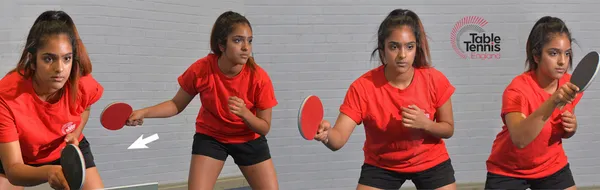
Start in a low, athletic stance, knees bent, weight on the balls of your feet. Your right foot sits slightly further back than your left if you are right-handed, which frees your hips to rotate. Stay low, because the loop is powered from the ground up and you cannot generate spin from a tall, stiff position.
Phase 2 - Backswing and Drop
Rotate back from the waist and load your weight onto your back leg. Let your racket drop down and back so it starts below the height of the ball, since you are going to brush upward through contact. Keep your arm relaxed. A tense arm is slow, and racket-head speed is where the spin comes from.
Phase 3 - The Brush
Drive up from your back leg, rotate your hips forward, and let your arm accelerate through the ball. Contact should feel like a thin brush up the back of the ball, not a solid hit.
Timing matters here. Catch the ball around the peak of its bounce for a standard loop, a touch earlier for a faster, flatter one, or a touch later for more arc and spin.
The single most useful cue I give beginners is to try to miss the ball. Swing as if you mean to whiff just behind it. You’ll clip the ball thin and fast, and thin is where the spin comes from.
Phase 4 - Follow Through and Recover
Let the stroke finish high, with your racket ending up somewhere around your forehead. Do not cut the swing short at contact, because a full follow-through is part of what generates the spin and keeps the shot consistent. Then recover straight back to your ready position, because a good loop often comes back for a second and third ball.
How to Tell It Is Working
A clean loop has a feel and a sound. The contact should be a soft brush, almost a shhht, rather than the sharp click of a flat hit. You should feel the ball stay on the rubber a fraction longer than on a drive, and it should leave in a curved arc that dips and then kicks forward off the bounce. A loud click and a flat, floating ball mean you hit through the ball instead of brushing up it.
Looping Against Backspin vs Topspin
This is the section that separates a reliable loop from a frustrating one. The stroke stays broadly the same, but your bat angle and swing direction change depending on the spin coming at you. Get these two wrong and the ball will go into the net or fly off the end.
The backspin drags the ball down, so open the bat and brush steeply up the back of the ball to lift it over the net.
The topspin kicks up and long, so close the bat and brush forward over the top of the ball to hold it down.
Against backspin, the spin is dragging the ball down toward the net, so your job is to lift it. Open the bat face, start lower, and brush steeply up the back of the ball. If the ball keeps diving into the net, you are too flat or too closed.
Against topspin, the spin wants to throw the ball up and long, so your job is to hold it down. Close the bat face, contact the ball a touch higher, and brush forward over the top rather than straight up. Loop it as if it were backspin and it sails off the end.
Read the incoming spin before you commit. The heavier the backspin, the more you open and lift; the heavier the topspin, the more you close and drive forward. When you are unsure, treat a low, slow ball as backspin and a rising, quick one as topspin.
Coaches disagree on one point here. Some teach you to keep the bat angle fairly constant and change only the swing direction and speed. That works well at higher levels, but when you are learning, exaggerating the open and closed angles above makes the difference obvious and gets you feeling the two contacts faster.
Common Mistakes on the Forehand Loop
Almost every looping problem I see in coaching traces back to one of these:
- Arming the ball. Swinging with the arm alone instead of loading the back leg and rotating the hips. The loop is a full-body shot, and an arm-only version has no spin and no consistency.
- Hitting instead of brushing. Making thick, solid contact out of a drive habit. Thin the contact out and let the racket speed do the work.
- Standing too tall. Starting upright leaves you no room to brush upward and no power from the legs. Bend your knees and get your whole stroke lower.
- Staying square to the table. Keeping both feet level blocks your hips from rotating and loading. Drop the dominant foot back a little.
- Wrong bat angle for the spin. The backspin and topspin mix-up covered above. It is worth its own line here because it is that common.
The Equipment That Makes Looping Easier
Technique comes first, and no rubber will loop for you. That said, some gear makes learning the loop considerably easier, and this is where the right setup earns its money.
On the rubber side, a grippy tensor rubber over a softer, springy sponge generates spin and speed at lower effort, which is forgiving while your technique is still forming. A tacky Chinese rubber can produce heavier spin at the top end, but it demands more power and cleaner technique to activate, so it is a harder place to start.
As a developing player, a softer, medium-thickness sponge is the easiest to loop with. The trade-offs are laid out in our guide to choosing a table tennis rubber, and if you are weighing sponge feel specifically, the rubber hardness guide and our breakdown of sponge thickness both go deeper.
Blades follow the same logic. An offensive blade, often with a carbon layer, gives you the speed and stiffness that reward a looping game, while a slower all-wood blade is easier to control but caps your topspin attack. When you are ready to shop, our roundups of the best table tennis rubbers and best table tennis blades sort the options by playing level and style.
A grippy tensor rubber in a medium sponge hardness at 1.9mm or 2.0mm, mounted on an offensive all-wood or single-carbon blade. There is plenty of spin and speed there when you brush well, and it stays forgiving while your technique is still developing.
One thing worth skipping while you learn is boosting. It squeezes extra spin out of a rubber, but it masks technique flaws and complicates upkeep, and you want honest feedback from your equipment while the stroke is forming.
Drills to Build Your Loop
Loops are built with repetition, ideally against a feed so you get the same ball over and over. Four that work:
- Multiball against backspin. Have a partner or coach feed a steady stream of backspin balls to your forehand while you open each one up with a loop. This is the fastest way to learn the lifting contact.
- Loop then drive. Open with a loop against a backspin ball, then follow with a faster loop or drive against the topspin block that comes back. This trains the backspin-to-topspin switch that trips up most players.
- Shadow strokes. Away from the table, rehearse the full stroke slowly, checking your low start, back-leg load, and high finish. Ten minutes of clean shadow play rewires a lot of bad habits.
- Loop and move. Loop one ball from your backhand corner, then step across to loop a wide forehand, training the stroke and your footwork together. A loop you cannot recover from is only half a shot.
If the loop is your gateway from steady rallying into real attacking play, it is worth reading our guide on going from casual to competitive table tennis, since the loop is usually the shot that makes that jump possible.
Useful Videos for Learning the Forehand Loop
Some things are easier to see than to read, so here are three videos worth watching on the loop.
Start with this breakdown from PingSkills. They walk through the start and finish positions clearly, which is the foundation everything else sits on.
Tom Lodziak has two that are worth your time. The first covers a reliable, spin-first loop that holds up under match pressure, which suits anyone whose loop feels powerful but inconsistent.
In the second, he brings in coach Ferenc Horvath for a set of tips to sharpen a loop you already have.
Forehand Loop FAQ
What is the difference between a forehand loop and a forehand drive?
A drive uses solid, direct contact to send the ball back with speed and a flatter trajectory. A loop uses thin, brushing contact and more racket-head speed to load the ball with heavy topspin, so it arcs over the net, dips, and kicks forward off the bounce. The loop is the bigger, more attacking stroke, and it is what most players graduate to after the forehand drive.
Can beginners learn to loop, or is it an advanced shot?
Beginners can start learning it, but only once the four basic shots are consistent, because the loop builds on the drive's weight transfer and rotation. The easiest place to begin is looping a backspin ball fed from multiball, where you have time to load your legs and brush upward.
Why do I keep hitting the net when I loop backspin?
Almost always because your bat is too closed or your swing is too flat. Backspin drags the ball downward, so against it you need to open the bat, start lower, and brush more steeply upward to lift the ball over the net.
Should I change my bat angle for backspin versus topspin?
Yes, especially while you are learning. Against backspin, open the bat and swing more upward. Against topspin, close the bat and brush forward over the top of the ball. More advanced players keep the angle steadier and vary the swing instead, but exaggerating the two angles early makes the difference easier to feel.
What rubber is best for learning to loop?
A grippy tensor rubber on a softer, medium-thickness sponge is the most forgiving choice, because it produces spin at lower effort. Tacky Chinese rubbers can generate heavier spin but need more power and cleaner technique. Our guide to choosing a table tennis rubber covers the trade-offs in detail.

Comments