
If we went back in time and told David Foster that one of his parlor games would become an Olympic sport 98 years after its creation, there’s no way he would believe us.
Table tennis was created with the intention of being a fun saloon game to pass the time. However, history led it to become an Olympic discipline.
We are going to explore the origins of table tennis and explain how the sport transitioned from a parlor game to an Olympic sport over the years.
The origins of Table Tennis
Table Tennis was presumably created by David Foster in 1890 as one of three parlor games, along with table cricket and table football.

Other versions of table tennis were made, using cork or rubber balls. None of these variants was successful and table tennis fell into oblivion for a few years.
However, it was the advent of the celluloid ball in the early 1900s that revived what we know today as table tennis.
In the 1920s, table tennis grew in popularity, so much so that in 1926 the ITTF was founded. The first edition of the World Table Tennis Championships was held in that same year and continues to this day.
This was the first major tournament in table tennis, and slowly new tactics, strategies, and rackets began to develop.
A few decades later, it was clear that table tennis was no longer lawn tennis adapted to a table, but rather, a unique and spectacular sport.
First attempts to include Table Tennis in the Olympics
Six years after the creation of the ITTF, in 1932, the International Table Tennis Federation tried to include table tennis as a demonstration sport in the 1936 Berlin Olympics.
However, the request was rejected. The ITTF continued with its intention to make table tennis an Olympic sport, but the following two editions, ‘40 and ‘44, were canceled due to the Second World War.
The ITTF continued its efforts to include table tennis in the Olympic Games, but London, the organizer of the ‘48 Olympic Games, believed that there were too many disciplines and that sports should be subtracted rather than added.
Also, table tennis had the World Table Tennis Championships. In the Olympic Games, priority was given to including disciplines that did not have World Championships.
At the ITTF annual meeting in ‘54, the acceptance of table tennis as an Olympic discipline was discussed again.
However, in 1957, it was decided that the time was not right to include table tennis in the Olympic Games and the decision was postponed.
Final attempt to include Table Tennis in the Olympics
In 1967, the last inclusion request was put forward. This proposal would end up being accepted 21 years later.
The French table tennis association pressed the ITTF to get table tennis into the Games, and the ITTF committed to getting more information.
Thus began the last negotiations between the ITTF and the Olympic Committee.
The biggest obstacle that table tennis presented was its constitution since it wasn’t explicit in it that the sport was amateur in any way.
Until the 1980s, the Olympic Committee required all athletes to be amateurs, until more and more cases of “shamateurism” occurred and the Olympic Committee began to accept professional athletes.
However, in the 1970s the Olympic Committee required the ITTF to declare that table tennis had an amateur facet.
By then, the sport had developed enormously, reaching Asian, European, and American countries, and it had already become professional, for example, in China.
The ITTF had already presented their proposal to be included as an Olympic sport, but seeing that it was extremely likely that it would be rejected, they decided to withdraw it.
In 1979, the ITTF changed its constitution in such a way that the Olympic Committee was satisfied and the Committee responded positively, voting for its inclusion in the Games in the year 1981.
Three years later, the Committee contacted the ITTF to include the sport as a demonstration discipline in Los Angeles 1984.
This never ended up happening, as table tennis would be introduced in the following edition, not as a demonstration discipline, but as an official discipline.
The Introduction of Table Tennis to the Olympics
Finally, and after so many attempts, table tennis was included in the 1988 Seoul Olympics.
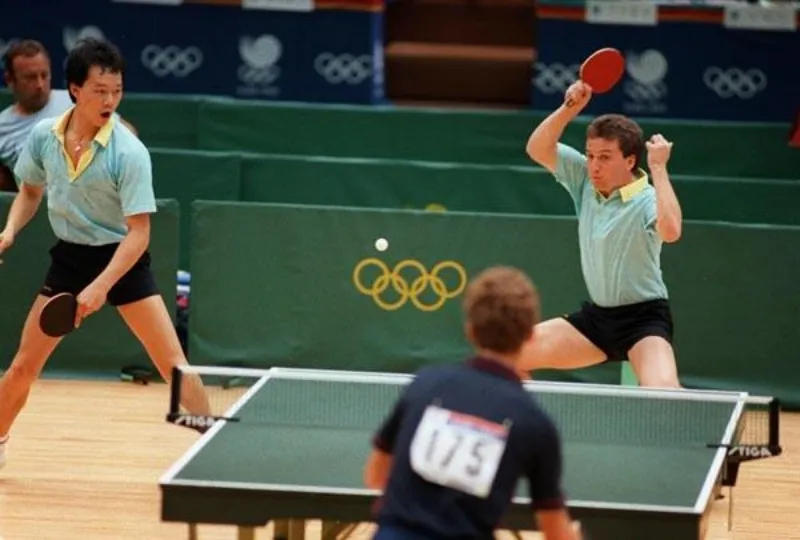 The 1988 Seoul Olympics
The discipline was officially introduced with 4 events: men’s singles, women’s singles, men’s doubles, and women’s doubles.
In the first edition, hosted in Seoul, athletes from the host country were extremely successful, winning 2 out of 4 medals.
Yoo Nam Kyu won the men’s singles event and Hyun Jung-Hwa and Yang Young-ja won the women’s doubles event.
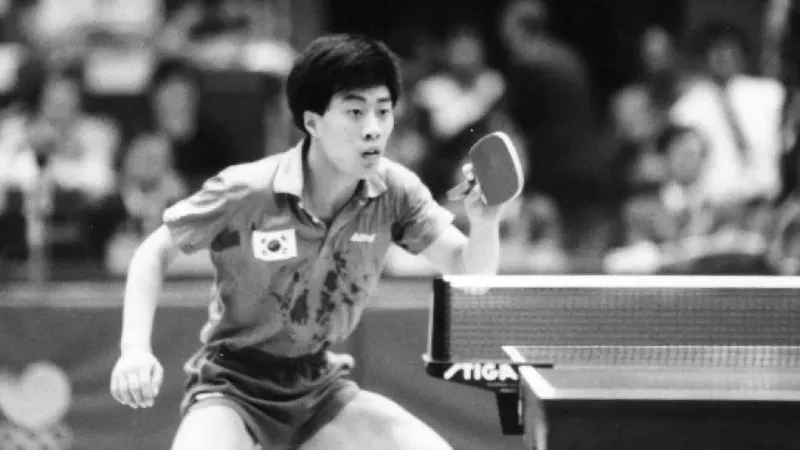 Yoo Nam Kyu, winner of the first men’s singles event
The other two medals were won by China. Chen Jing won the women’s singles event and Chen Longcan and Wei Qingguang won the men’s doubles event.
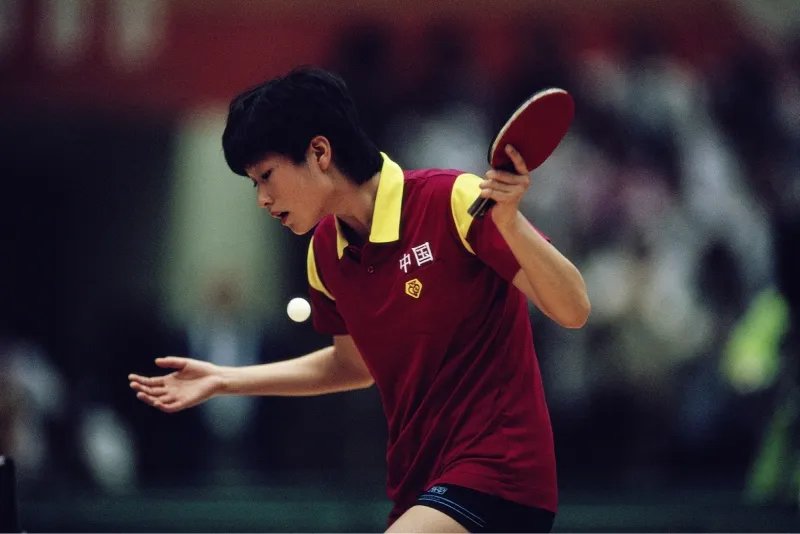 Chen Jing, winner of the first women’s singles event
Interestingly, these two events that China won were, to this day, never won by other nations.
In the women’s singles event and men’s doubles, China won 18/18 events. They are still undefeated.
In the rest of the events, they are also tremendously dominant.
They won absolutely every event except the men’s singles in 1988, 1992, and 2004, the women’s doubles in 1988, and the inaugural mixed doubles event in 2020. All other events were won by Chinese athletes.
In 2008, men’s team and women’s team events were added, and in 2020, the mixed doubles event was included to form 7 different events. The inaugural mixed doubles event was won by Japan.
 The 2020 mixed doubles champions, Mima Ito and Jun Mizutani. Source: Japan Times
Paris 2024: China’s Historic Clean Sweep
The Paris 2024 Olympics saw China reassert total dominance over the sport, sweeping all five gold medals in table tennis.
The mixed doubles event kicked off the table tennis program on July 30, with Wang Chuqin and Sun Yingsha defeating North Korea’s Ri Jong Sik and Kim Kum Yong 4-2 to reclaim the title that Japan had won in Tokyo.
In the men’s singles final, Fan Zhendong overcame Sweden’s Truls Moregardh 4-1 to win his first individual Olympic gold. Meanwhile, 17-year-old Felix Lebrun of France claimed bronze, becoming the youngest men’s singles medalist in Olympic table tennis history.
Defending champion Chen Meng retained her women’s singles title, defeating teammate Sun Yingsha 4-2 in an all-Chinese final. Japan’s Hina Hayata earned the bronze medal.
In the team events, China’s men (Ma Long, Wang Chuqin, and Fan Zhendong) defeated Sweden 3-0 in a tense final where each match went to five games. The women’s team of Sun Yingsha, Chen Meng, and Wang Manyu beat Japan 3-0, marking China’s 300th Summer Olympics gold medal in history.
Perhaps the most significant storyline was Ma Long’s farewell. The legendary player won his sixth Olympic gold medal, more than any other table tennis player in history, and announced his retirement from major international championships after the team final. With six golds across four consecutive Olympic Games, Ma Long cemented his legacy as the greatest table tennis Olympian of all time.
Felix Lebrun was another standout, winning two bronze medals (singles and team) and thrilling the home crowd at the South Paris Arena. His performances, alongside brother Alexis Lebrun, signaled a bright future for French table tennis.
Table tennis will return at the 2028 Los Angeles Olympics, where a new generation of players will look to challenge China’s dominance.
To find out more about table tennis at the Olympics, check out our guide to Olympic table tennis rules.



Comments